
.jpg)
Texas A&M
Visualization Program
Texas A&M Visualization Program Orientation
Facing the twin challenges of program growth and aging on-premise infrastructure, the Texas A&M University Visualization program has been working towards a transformative solution for their demanding workloads on behalf of faculty, staff, and students. They partnered with Arch Platform Technologies and Amazon Web Services (AWS) to deploy the Arch Platform for hybrid-cloud virtual computer labs and a compute farm.
This strategic transition moves beyond simple lab virtualization. It establishes a model for compute equity, providing every student with 24/7/365 access to a right-sized virtual workstation and compute farm resources, regardless of their personal device or physical location. By eliminating cyclical resource congestion and level-setting the student experience, the Arch Platform has provided the foundation for a scalable, future-proof curriculum.
Texas A&M Visualization Program Background
Prior to Arch, Department IT Administration Perspective:
The following factors were instrumental to the Visualization program deciding to move to a cloud-based render farm:
● Student Traffic & Capacity Challenges:
"With the Visualization program’s Linux pipeline, the on-prem render farm was already reaching max capacity in traffic and scalability. During final project weeks, render traffic would become so congested that Pipeline Technicians would manually queue jobs to ensure fair allotment of resources."
And, with the creation of the College of Performance, Visualization, and Fine Arts (PVFA) in Fall 2022, there was an understanding that the College and the Visualization program would grow in enrollment in coming years.
● Move to Windows:
Program growth outside of animation-based classes saw a heavy uptick in Unreal usage. As a result, the decision was made in Fall 2023 to renovate all Visualization computer labs to be exclusively Windows machines. This meant that a new pipeline solution needed to be developed, because the legacy pipeline was Linux/Unix based.
● Infrastructure Constraints:
Outside factors that limited the growth of the compute farm include the inability to support more workstation render nodes due to power constraints within University facilities and having a dispersed set of computers aging in computational power. This latter challenge created an inequity of resources, because students knew which computers were “newer and better ones,” and they would retry render jobs until a “good” computer picked up the job.
Prior to Arch, Pipeline & Compute Farms:
● On-Prem Linux (~2012 to 2024):
The render farm consisted of UNIX-based computers that were managed by the Visualization program, representing roughly 75 machines across four lab spaces. This render farm used Pixar’s Tractor 2 as the farm manager and would allow workstations to serve as render nodes when no users were logged into the machine. An additional lab of 25 Windows-based computers was available, but these machines were not part of the pipeline due to the pipeline being UNIX-based. Installing additional machines was a challenge due to space constraints and power concerns; the building housing the render farm has a history of electrical limitations in the aforementioned labs. Workstation lifecycles were also out of sync, with some areas of the lab having newer machines compared to others.
● Self-Managed AWS Deadline Spot (Aug 2023 to Dec 2024):
The move from UNIX to Windows-based computer labs was finalized after the College of Performance, Visualization, and Fine Arts’s first year in 2023. Although all labs were overhauled to be Windows-based, the total number of workstations needed meant that old workstations nearing end-of-cycle were kept in circulation to maximize available space. This pipeline used Hammerspace as the storage provider and was the first-use of cloud rendering with a self-managed spot fleet through AWS Thinkbox Deadline. This pipeline was problematic in ways that impacted students firsthand, including massive delays related to syncing completed render frames with the storage, along with an over-reliance on the pipeline architect when the spot fleet became unhealthy.
● Unofficial Self-Managed AWS Workstations (June 2023 to July 2023):
A self-managed Windows virtual workstation through AWS was used during a partnership course with DreamWorks. It was a test for a Windows-based pipeline and cloud workstations. Students were given a direct access link to an existing AWS EC2 instance, which was preloaded with the necessary applications and licenses needed for their project. This POC was short-lived as students commented on high latency and workstation performance issues, and they eventually asked to move back to the Linux pipeline midway through the project.
Transitioning to the Arch Platform and AWS
The Arch solution was designed around four key themes to directly address Texas A&M's challenges, utilizing a hybrid-cloud model with AWS.
The solution eliminated resource disparity by providing uniform access to pre-configured, right-sized virtual workstations for every enrolled student. This ensures that all students, regardless of personal hardware or financial means, experience the same high-performance environment. As one student shared, the on-premise challenge reflected that "not all of the computers run the same, and taking the time to set up one workstation only to find out it's too slow is a notable waste of time." Arch solves this by standardizing the experience.
1. Equality of Compute Resource Access
The hybrid-cloud Virtual Desktop Infrastructure (VDI) enables 24/7/365 access to virtual workstations, asset storage, and compute clusters from any internet-connected device.
2. Flexibility, Personal Safety, and Remote Collaboration
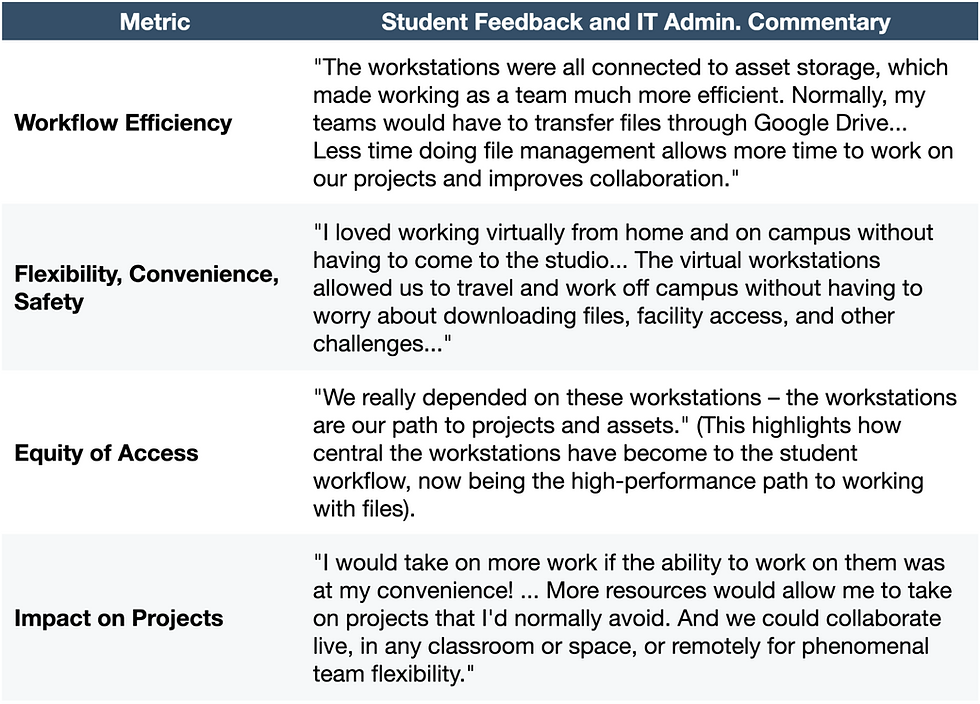
Remote Work: The convenience of Arch Portal workstations reduces students' friction and limitations related to physically coming into the lab, confirming the success of the remote access model. Students appreciated the safety of not working late at the lab. Many also live farther away so virtual access is important for feasibility to work remotely without time and traffic commute challenges.
Collaboration: Instructors and students noted important improvement in teamwork: "Virtual workstations have made group collaboration much easier. Always having access to the campus high performance asset storage and workstations wherever you are has made file and project collaboration with team members much easier."
The Arch Platform’s AWS cloud-based compute farm provides elastic scalability, allowing resources to be dynamically scaled up and down, with comprehensive provisioning control, to meet peak demand. This cost-effective approach eliminates the congestion bottleneck around project due dates. Students acknowledged the clear impact of this:
3. Cloud Compute Farm Scalability
"Cloud render farms make rendering much faster, efficient, and easier... Having the assurance that you have the resources you need to render your projects more effectively allows you to spend more time on refining your final product."
4. Virtual Lab IT Management Perspective
Centralized management of virtual workstation and compute farm configurations dramatically reduces IT overhead. Software updates and configuration changes can be instantly rolled out across the entire virtual fleet, as opposed to the 2-4 weeks required for manual physical configuration, testing, and rollout in the previous on-premise model. Importantly, it facilitates rapid scaling to each term or semester so we pay for what we need at any given moment. This frees up cost and time for more strategic tasks.
Student Workflow: Key Benefits
The transition to Arch has fundamentally changed the workflow for students in the Visualization program, making the entire production pipeline more efficient and equitable.

Flexibility and Room to Move
The hybrid-cloud Virtual Desktop Infrastructure (VDI) and elastic compute farm offer a future-proof foundation capable of absorbing the rising computational demands of next-generation visualization pipelines and the accelerating adoption of AI/ML workflows.
● Cloud Agile Integration of AI:
The Arch Platform's architecture provides the flexibility to rapidly onboard and provision resources for new AI-driven tools, such as generative art models, machine learning-enhanced rendering, and real-time simulation engines. This centralized and standardized environment allows IT to instantly deploy specialized software and hardware configurations across the entire virtual fleet, enabling the curriculum to pivot at the speed of innovation.
● Elastic Scalability for New Pipelines:
As visualization pipelines evolve, moving toward more computationally intensive tasks like complex real-time ray tracing and massive data visualization, the compute farm’s elastic scalability ensures that peak demands can be met instantly. This eliminates the risk of an on-premise infrastructure bottleneck, guaranteeing that students, faculty, and staff always have the resources required to explore and master emerging industry standards, keeping Texas A&M at the forefront.
● Curricular Freedom:
By decoupling compute resources from physical lab space, the platform provides ultimate flexibility for program growth and new course development. This means the Visualization program can expand its offerings and explore cutting-edge technologies without being constrained by classroom infrastructure limitations, building power, cooling, or a lengthy procurement cycle for physical hardware.
The Texas A&M Visualization program’s transition to the Arch Platform on AWS is more than an IT upgrade. It is a fundamental shift that has enshrined compute equity as a core principle of their curriculum. By decoupling high-performance resources from the constraints of physical space and aging hardware, Texas A&M has eliminated the friction that once bottlenecked creative and technical workflows, replacing it with a high-performance environment that eliminates configuration drift and that is accessible to every student, everywhere, at any time.
It’s a Wrap
This foundation of equitable access and elastic scalability with efficient IT management overhead is the program’s new guarantee, a future-proof promise to students, faculty, and staff. It ensures that as the worlds of visualization and big data/AI accelerate, Texas A&M will retain educational leadership. The Arch Platform on AWS is a solution to today's challenges that assists the evolution to tomorrow’s innovation, empowering the next generation of creators, designers, and engineers to explore, create, and master emerging technologies.
Business Objectives
-
Rapid scaling
-
GPU compute
-
Student equity
-
Low-latency remote access & brokering
-
No resource congestion
-
Future-proof
-
Cost-effective
-
Support efficiency
Benefits
Texas A&M has eliminated the friction that once bottlenecked creative and technical workflows, replacing it with a high-performance environment that eliminates configuration drift and that is accessible to every student, everywhere.
"For compute-intensive workflows, Arch Platform's success is its ability to provide resource equity and 24/7 access to high-powered workstations whether on-prem or in the cloud. This fundamentally solves the unequal access and bottlenecks that plagued our on-prem pipeline."
Nicholas Mireles
Pipeline Engineer
Texas A&M


